Showing posts with label Compost Factory Guild. Show all posts

Tuesday, December 16, 2008

Grocer to Garden - Lemongrass, Ginger, and Taro (part 3)

Grocer to Garden is a running experiment, taking produce from the grocery store and testing out techniques to propagate them into plants. The first candidates are lemongrass, ginger, and taro.  This is the third update, you can see the rest of the story here.  Commentary to follow, here are the pics.

Lemongrass

Ginger
OK, so it was 20 days under soil, but that's some nice growth.

Taro
Hassah!  Looks like the more submerged corm has taken a big lead.  The other bud which revealed in our last update hasn't grown much, but much more lies beneath the surface...

Thursday, December 4, 2008

Grocer to Garden - Lemongrass, Ginger, and Taro (Part 2)

Grocer to Garden is a running experiment, taking produce from the grocery store and testing out techniques to propagate them into plants. The first candidates are lemongrass, ginger, and taro. One week later, here's the first update. For those of you catching up, the original post is here.

Lemongrass
Some new roots have formed, and I am pretty sure that two of them were not there this afternoon. One commentary I read said that you should peel some of the outer layers off of the stalk before dropping them in water. I might try that next time to compare results. Maybe a side by side test? Either way, the results are encouraging enough.


You can click on the pictures to get a closer view

Taro
Little green tips are popping out of the taro corms, and there seems to be more just below the surface ready to pop out. Some gardeners recommend a bit more of the corm sitting above the surface, so that would be a neat variation to test out. So far, this too seems to be going well, and I am thinking about picking up a few more corms the next time I go food shopping.


Both


Left


Right

Ginger
Nothing to report here. For this one, I've been referring to Pam Peirce's Golden Gate Gardening, so I'm following her recommendation here to wait two weeks to gauge the progress.
"Dig them up and check them in two weeks to see if buds are beginning to form. If not, just wash the rhizomes, dry them, and set them aside to eat- some ginger rhizomes just won't grow- and try rhizomes from another source."
So one week down, one to go. Go rhizomes! I'm a bit worried about the ginger not being moist enough the last two days. But on a positive note, it never dried out or was too soggy.

That's all for now, stay tuned as we'll revisit this next week, when we dig up the ginger and track the progress of the whole project.

I've found
Golden Gate Gardening to be a fine resource to cross-reference in my recent research efforts. You can sneak a peak in the book here, and CRFG has reviewed the book, which you can find here. If you have any ideas or feedback, be sure to post a comment.

Tuesday, November 25, 2008

Grocer to Garden - Lemongrass, Ginger, and Taro


.
A little experiment brewing here. I purchased two taro root corms, one large-ish piece of organic ginger and two stalks of organic lemongrass from the local grocery store. Here's what I did so far...

Lemongrass
Requires - one clean apple cider jar, a rubber band, two sticks, and water. Bound the two stalks with a rubber band (not too tight) and used two sticks to suspend the bunch in the water.


Ginger & Taro
Requires - 2 terracotta bulb pots (10-inch), some potting mix, some water. Two 3 inch pieces of Ginger layed horizontally 2-3 inches below the soil. Two taro balls placed vertically, partially buried, with a little bit peeking above ground. Just add water.


Ginger (not much to see here)


Taro, take a closer look at the two little taro roots popping out of the ground.

Check out this nifty collection of Vegetables from the Undeground, including taro. Those folks at University of Queensland - Australia sure do their homework. And this bunch of lemongrass went from the Grocer to Garden at "Happy Forest Farm", yay. Of course, if you've been following along, then you probably noticed that these are all possible components in the Compost Factory Guild.

Thursday, November 20, 2008

Compost Factory


Just an idea, thoughts, concerns, corrections and general feedback encouraged, needed.

Start with a Banana Cirle
Stacks many functions: compact fruit producers, consumers of organic matter, they can store, channel, or just slow down water (esp. greywater), provide a number of interesting microclimates to work with, they grow pretty quick, don't require a whole lot of maintenance, send up many viable offspring in the form of suckers


Circle into Semi-circle
To take advantage of the thermal mass in the wall (and rocks).


Mound into Crescent
The donut-shaped mound formed around the circular pit becomes more crescent shaped (or croissant-shaped) when placed on a slope, creating more surface area and edge.


What do we have so far?
  • compact fruit producer
  • consumer of organic matter
  • potent component in a greywater system
  • variety of microclimates
  • increased surface area and edge
  • increased biodiversity in the canopy layer of the urban food forest (mostly fruit and nut trees)easy propagation through division of suckers
Locating on the site
A high-point along the western wall should get morning sun and afternoon shade, which should not change much when the entire canopy fills in. Functional use of location, feeds everything down the slope. This combination of exposure, temperature, moisture and fertility creates an outdoor environment similar to a greenhouse or nursery.

Now what have we added?
  • Out-of-the-way of the flow of energy and traffic, a spot to toss any organic matter, prunings, brush, weeds, coffee grinds, greywater, and more
  • great place to compost, when bins or a heap may not be right for the location
  • gravity-powered producer and passive distributor of water and soil nutrients
  • living nursery conditions to propagate from and raise plants for other guilds

Relationships in the plant community
A Worm Pit, a similar application of a sunken pit compost producer is another intriguing option for the spot. In Start a Biodvierse Worm Pit there is a warning, "Be sure to place your pit away from large trees because they will love the soil and invade."

The established trees in the SE corner (oaks and olive) are about as far as possible, the buckeye is going be an indicator of this effect a bit, but the slope could help battle this. I suppose if the buckeye does well, the placement at this location is performing.

Fortess Barrier Guild (a.k.a. the forester)– comfrey (deep root) + ginger (shallow, bulbous root) + lemongrass (wiry root) + perennial peanut (groundcover) closely planted along a perimeter creating a densely woven root wall and groundcover. Originally used around a perimeter of a huge kitchen garden, in this application, it is hoped that the underground barrier thrives while protecting the pit, and in turn provides cuttings and divisions for future garden beds and fortresses.


The Compost Factory Guild - Bananas on the crescent mound with densely planted Russian comfrey, ginger (or other tall clumper with shallow, bulbous root,), cape gooseberry (or another fruity/berry shrub) , cayenne pepper, taro (or some Alocasia/Colocasia) along inner rim of pit, perennial peanut groundcover on lower-part of mound and around rocks, sweet potato or other ground cover on upper-part of mound and cooler spots. Lemongrass in and around path and perimeter. Some stones for additional thermal mass, stepping stones, path border in places. Leveled-off "lip" where base of mound meets the top of the path, creating another egde to plant Climber on fence/wall which can also fill in the edge and spread to climb on other guild trees (perhaps passion-fruit, but nasturtium, another bean, or flowering climber could work). In general, it would be nice to install plants which divide easily, utilize the space to maintain mother plants for certain valuable species. Spillway where the pit meets the corners of the croissant, accounting for ther possibility of a flooding rain filling the pit.

Do you think we need more flowers in the area? Use the comments feature to continue the discussion.

Musa acuminata 'Raja Puri'
is a cold-hearty, fast growing, dwarf banana which can produce delicious little bananas. It should grow to 8-12 feet tall, the root is bulbous, it sends up offspring in the form of suckers which can be separated and planted .

Symphytum x uplandicum is the Bocking 14 cultivar of Russian comfrey. Bocking 14 is a seedless, vigorous variety of Russian comfrey with a deep root system and an extraordinary appetite for nitrogen. It divides from root cuttings and is a crucial component in the complex, layered root system of the fortress barrier.

Zingiber officinale - Ginger
will form the understory under the banana canopy, with a shallow, bulbous root it and tall "poles" it takes advantage of empty vertical space above ground and below.

Physalis peruviana - Cape Gooseberry, or perhaps Physalis pruinosa - Dwarf Cape Gooseberry, a variety that grows to about 1.5 feet

Capsicum annuum -
Cayenne Pepper may thrive in the warmer conditions near the wall.

Colocasia esculenta - Taro
should do pretty well in the wettest areas in and around the pit.

Arachis pintoi - Pinto Peanut or Perennial Peanut is a low-maintenance, perennial, nitrogen-fixing groundcover which will help stabilize the soil on the mound and can also spread onto the path and, once established, can handle foot traffic and propagates easily from cuttings.
I've seen it create beautiful garden pathways, used for erosion control on a slope, and thrive for years in the medians and curbs of a heavily trafficked highway. Just a few of the reasons this plant is so wonderful. There are other studies on its impact as a groundcover under bananas, citrus, and macadamia, some of which aren't favorable (primarily in a monocrop or commercial orchard setting), so a fair warning about that and a few reminders on appropriate use in design, biodiversity, and the like.

Ipomoea batatas - Sweet Potato is another fast growing, nitro-fixing, groundcover / creeping vine which may grow on the mound in reach places where the pintoi would not.

Cymbopogon citratus - Lemongrass is the final seal on the fortress barrier guild, with its long wiry root filling in the remaining gaps below ground. Similar to mint on the edge of a path, it release wonderful smells when brushed up against. Also known as the citronella plant, it repels mosquitos and attracts beneficial insects.

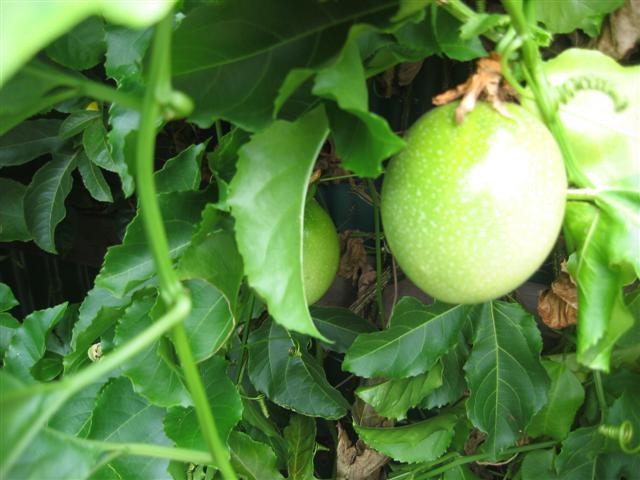
Passiflora edulis - Passionfruit as a possible vine which may work on the wall and spread to the avocado or other nearby planned trees, and its flower is mind-boggling.

For more on banana circles, check out this fine article from the PRI, Build a Banana Circle. This guy has a few nifty diagrams, here, although I think a 1 – 1.5m deep pit would be a bit dangerous. (What is that, like 5 feet deep?!) But the rest of his numbers seem about right, and his goals are in line.
  • Easy, large, production from a small space
  • Multi-crop system
  • Consume organic waste - especially from bananas.
  • Retain moisture, or soak up excess
  • Easy access for harvesting
  • A tidy way of growing Bananas
  • Grey water sink - including for Laundry
Plus he provides a neat diagram of banana succession. And then there is this diagram, from the University of Queensland, Australia, great stuff!

Anyway, I really liked the idea of the compost pit feeding the mound. It's a natural pairing, right? Dig a hole, build a mound.

Feed the hole, the hole feeds the mound, the mound feeds you.

If you have a chance, you must see the composting system in the RDI-designed garden at IONS. The above ground compost piles were enclosed in bales of hay with a plywood cover. Simple, neat, brilliant. When the compost was finished, you could pull some of the hay (or all of it if you are wealthy in hay), it's a super-charged mulch, and then you build another one. The heap was "tractored' across a path along the top of the slope, feeding everything below. I really liked the functional benefits of placing the compost at the top of a slope.

And a few more thoughts on bananas. The banana leaf can be used for many things, when water was scarce, we used them for plates rather than having to wash dishes. The banana flower is an indicator of the fruit's readiness for harvest. Once it starts to drop it's petals, the bunch is just about ready to be enjoyed. After the banana fruit is harvested, that "tree" is done, so you chop it down, then cut it into a few log-like pieces, and feed it to the offspring. The first time I tried this with a hand saw, I was not very successful and wound up covered in the very sticky "sap". By the next day, I had learned that the appropriate tool for this is a machete, but I'm not sure if I will be able to take that on the bus!

For more on pinto peanut, check out the abstract for this in-depth study on it as a "multipurpose cover crop that might be used as a living mulch in no-till vegetable production fields and orchards, forage for animal feeding, and ornamental ground cover along highway ramps and sidewalks."

Links:


More useful info on bananas and the source of some of those great diagrams: